Double Indemnity

Updated: Apr 6

Ciaran Owens and Miscah Barton in Double Indemnity. Image, Manuel Harlan
***
When it first hit the screens in 1944 James M. Cain’s classic thriller Double Indemnity appeared to break with cinema noir rules. But look closely and it just repositioned things. The genre’s hard edged, world weary, anti-hero detectives are now insurance investigators. Everything else remains intact. A sultry femme fatale, a self assured secretary, a good girl daughter, a self-made millionaire, a booze bottle in the bottom desk drawer, efforts to commit the perfect murder and the Hollywood sign looming above it all. All present and correct in Tom Holloway’s atmospheric stage adaptation. But noir is more than a matter of generic tropes. It’s a cinematic language. Mood light and shadows, close ups and extreme close-ups, snappy repartee all define its world weary glamour. The shift from screen to stage losing something for remaining in long shot. Like an old photo catching the moment but not the memory. Even so, Hollander’s adaptation adds fresh details and a new twist to the ending, ensuring fans and first timers are sure to be kept guessing.
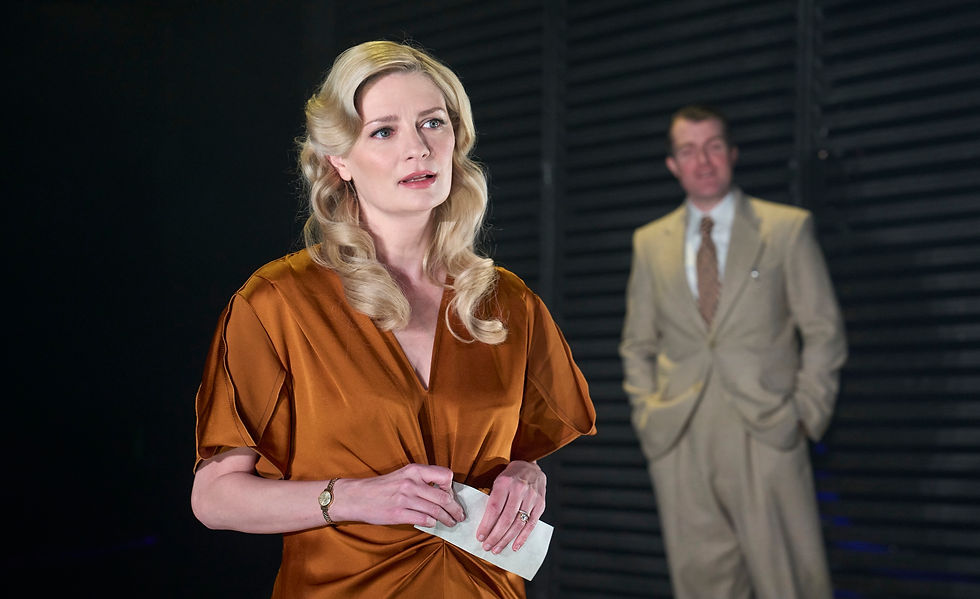
Miscah Barton and Ciaran Owens in Double Indemnity. Image, Manuel Harlan
The story still revolves around Walter Huff discovering there’s more to murder than meets the eye. Huff, an insurance investigator, along with bored, calculating housewife, Mrs Phyllis Nirdlinger, sets out to kill her husband having tricked him into buying an insurance policy that pays double if he dies on a train. Huff’s best laid murder coming apart as his tenacious boss Keyes digs deeper. Revealing secrets about the woman Huff lusts after, culminating in an ending he didn’t see coming. Oscar Toeman's direction trying to balance the drag of storytelling, first person narrative with high octane, action driven scenes. The former feeling rushed and hurried, the second crackling with energy. A brilliant argument between Huff, Keyes and their mutual boss, Norton, fizzing with expectation. Leaving you wishing Huff had talked less and that there’d been more dynamic scenes.

Ciaran Owens, Joseph Langdon, Martin Marquez in Double Indemnity. Image, Manuel Harlan
With characters made legendary by Barbara Stanwyck, Fred MacMurray and Edward G. Robinson, Double Indemnity has big shoes to fill. Ciarán Owens, channelling MacMurray at times, sees Huff trade some of his weary solidness for a frustrated energy. Mischa Barton, forsaking Stanwyck’s hardness for glamorous allure, portrays Phyllis as a long, languid Veronica Lake with a hint of Bacall huskiness.Yet the chemistry between Huff and Phyllis never quite ignites, their scenes hurried rather than seductive. The strongest interactions often coming from superb supporting performances. Martin Marquez terrific as Keyes enjoined in a surrogate father-son relationship with Huff. Oliver Ryan excellent as the argumentative Mr Nirdlinger. Joseph Langdon also superb as the defiant Norton, as is Sophie Roberts as good daughter, Lola, and a scene stealing Gillian Asker as secretary Nettie. Nettie far smarter than all the men around her. As is Barton’s ruthless Phyllis.

Gillian Saker and Ciaran Owens in Double Indemnity. Image, Manuel Harlan
For first timers, Double Indemnity offers much to enjoy when not dragging its heels. For fans, some will feel Hollander and Toeman have taken too many liberties. Joshua Gatsby's lighting might play with the shadows, but Ti Green’s gun grey set looks more like a nuclear bunker under the Hollywood sign than a noir landscape. Dan Balfour’s composition might do enough, but it lacks the power of Miklós Rózsa evocative score. Even so, Double Indemnity cracks along at pace, serves up a surprise or two, and Barton never looks less than iconic.
Double Indemnity by James M.Cain, adapted by Tom Holloway, presented by Trafalgar Theatre Production, runs at The Gaiety Theatre until March 28.
For more information visit The Gaiety Theatre


