The Good Luck Club


Ciara Molloy, Ghaliah Conroy, Pattie Maguire, Libby Conway Dunne, Eimear Hussey in The Good Luck Club.
Photo: Patricio Cassinoni
*****
Memory’s a living thing. We live memories, live in our memories, relive our memories. Our world, bodies and culture all psychosomatically shaped by the contractions and convulsions of memory. Memory denied, embraced, erased, suppressed, repressed, refashioned, romanticised. Otherwise known as history. A habit whose outcomes are often unquestioned or deemed inevitable. Another of the devil’s tricks. In ANU’s The Good Luck Club, Ireland’s repository of the State’s history, The National Archives, might seem an unlikely site for a promenade, immersive work on The Irish Hospital Sweepstakes. The National Archives, with its modern functionalism, a space where a different history happened and where recent history is housed. Yet Director Louise Lowe and her cohort of revisionist, theatrical historians understand that The National Archives is a house of restless ghosts. Glimpsed at the end of corridors, dancing through vaults like passions, sequestered at shadowed tables as deals are struck that shape and reshape memory. It's all there, buried alive in coffined boxes, if you know where to look. And Lowe knows not just where to look, but how to look. How to sequence information into stories of characters that reveal hidden truths so as to bring them into the light. Indeed, you might be surprised what The Good Luck Club uncovers. For when it comes to a thrilling, true life tale of political intrigue and organised crime, forget The Irishman. The Good Luck Club is the greatest Irish gangster story never told.
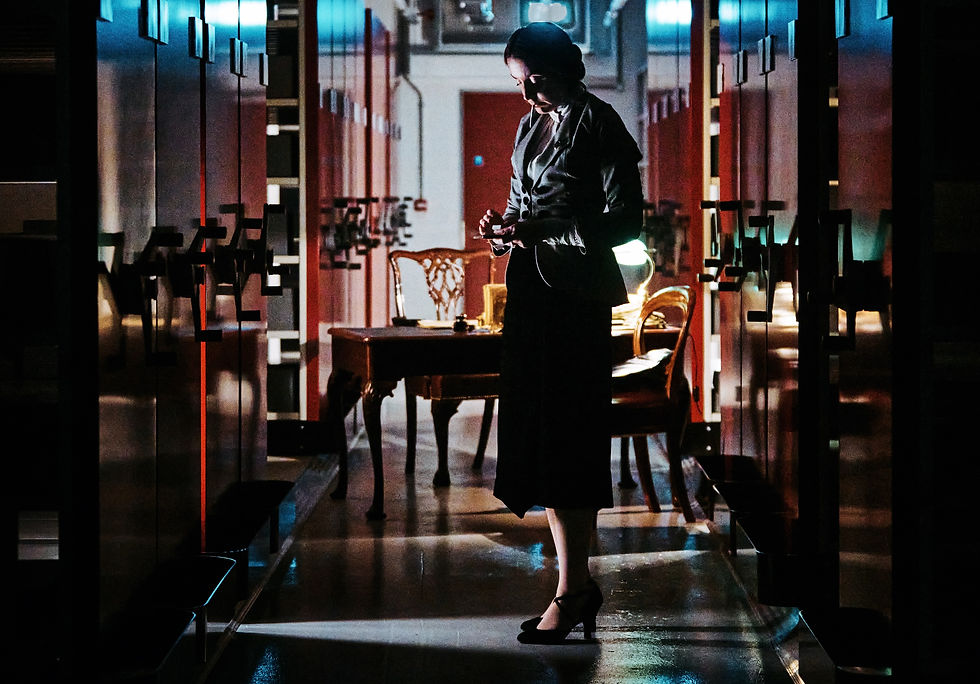
Maeve Fitzgerald in The Good Luck Club. Photo: Patricio Cassinoni
A global precursor to the National Lottery that ran from 1930 till 1987, The Irish Hospital Sweepstakes promised the possibility of riches for the measly price of a sweepstakes ticket. Purporting to finance Irish Hospitals, its tri-yearly draw at staggering odds give pundits hope, hospitals financial support, and made its organisers very rich. Funnelling money into industrial enterprises like Waterford Glass and the Irish Glass Bottle Company, it created up to 5,000 jobs on behalf of the State. Yet from 1930 to 1939, the period covered in The Good Luck Club, The Sweepstakes operated a secret agenda of funding the IRA in preparation for a renewed anti-treaty campaign to force Britain to forego all claims to Ireland. The secretive Plan S seeing The Sweepstakes take to America in legal, and not so legal ways so as to fund the IRA’s coffers. Lowe’s tale as much a character study of those involved as of the events that took place. Including remarkable women rubbed out, or pushed aside into archived boxes, left there to be forgotten.
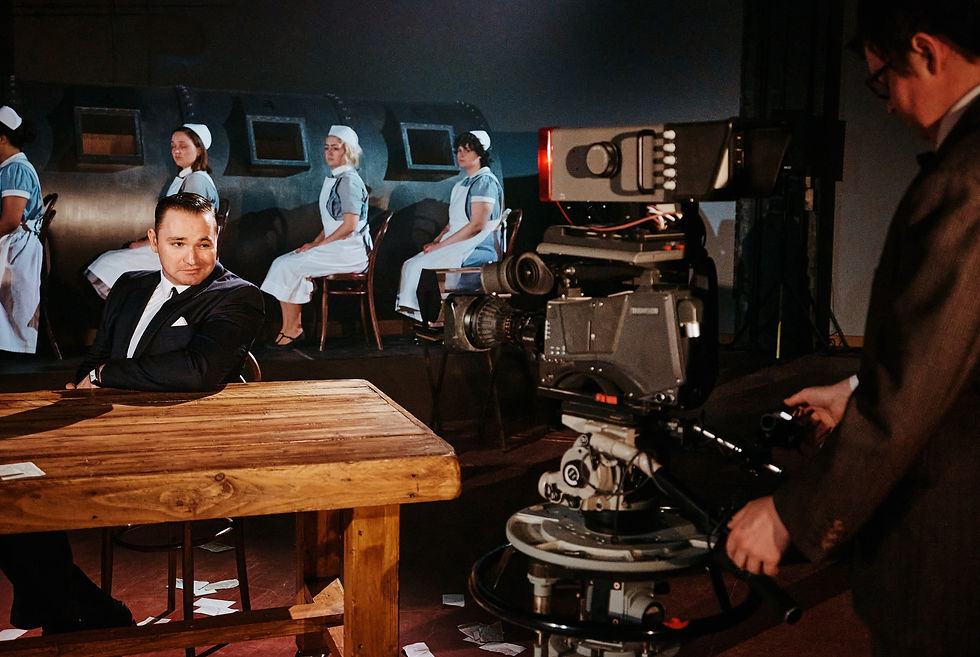
Pattie Maguire, Libby Conway Dunne, Eimear Hussey (back) , Oliver Flitcroft and Jack Hassett in The Good Luck Club.
Photo: Patricio Cassinoni
If its site specific engagement feels ANU familiar, closer inspection reveals subtle distinctions. In contrast to previous productions where locations practically spoke, The National Archives’ corridors, newly and currently renovated, feel clinical and bare. The building, a hybrid of past and present, might hark back to the Jacob Biscuit Factory occupied by Thomas McDonagh during the 1916 Rising, but its current incarnation defines it. Boxes upon boxes, vaults upon vaults, corridors upon corridors suggest unchanging uniformity aside from dates and labels. Boxed memories of a fledgling nation trying to create its own memories, collected and gathered as information. Yet The Good Luck Club not only gives life to The National Archives' content, but to the space as historically potent, even if the smell of fresh paint suggests nothing older than yesterday. A space embracing the future by never taking leave of the past. A space more than simply a repository for primary sources. Owen Boss’s exceptional design and scenography transforming The National Archives into a liminal landscape, less about memories so much as the space within where memories reside and are created. Mae Leahy’s staggeringly detailed period costumes, washed under Sinéad Wallace’s mood filled lights, highlighting both the events as they unfold and the National Archives as susceptible to revealing powerful, forgotten truths. Rob Moloney’s haunting score and Aidah Sama’s enriching sound design whispering of secrets found in sounds of a present past. All in all, a technical tour de force.

Oliver Flitcroft and Jack Hassett in The Good Luck Club. Photo: Patricio Cassinoni
Then there’s Lowe’s immaculate writing, to which Raymond Chandler would gladly have given his seal of approval. Taut, economic, making greater concession to narrative arc, The Good Luck Club achieves that rare cohesion to become enlightening entertainment. Whether serious historian of lover of pulp fiction, Lowe’s sublimely detailed script has you covered. As does The Good Luck Club’s impeccable cast, many playing several roles, shredding every ounce of performative fat to deliver riveting encounters. Oliver Flitcroft’s excellent Joe McGrath, one of The Sweepstake’s primary movers and shakers, oozes with smarmy, razor blade charm. Maeve Fitzgerald fierce as the formidably divine mathematician Dora Metcalf. John Cronin as a frustrated director and menacingly considerate interrogator utterly irresistible. Relative newbie Jack Hassett just extraordinary in a range of roles. Jamie O’Neill superb as what is essentially an Irish mob boss. Then there’s the heavenly coven of Ciara Molloy, Pattie Maguire, Libby Conway Dunne and Ghaliah Conroy, the latter’s choreographed sequences both gripping and breathtaking. Like Fitzgerald’s unsung heroine, these women fume in exasperated insolence at being forced to compromise and be compromised in order to survive. There’s no one performance you can really single out. This is an ensemble where when one wins, all win.
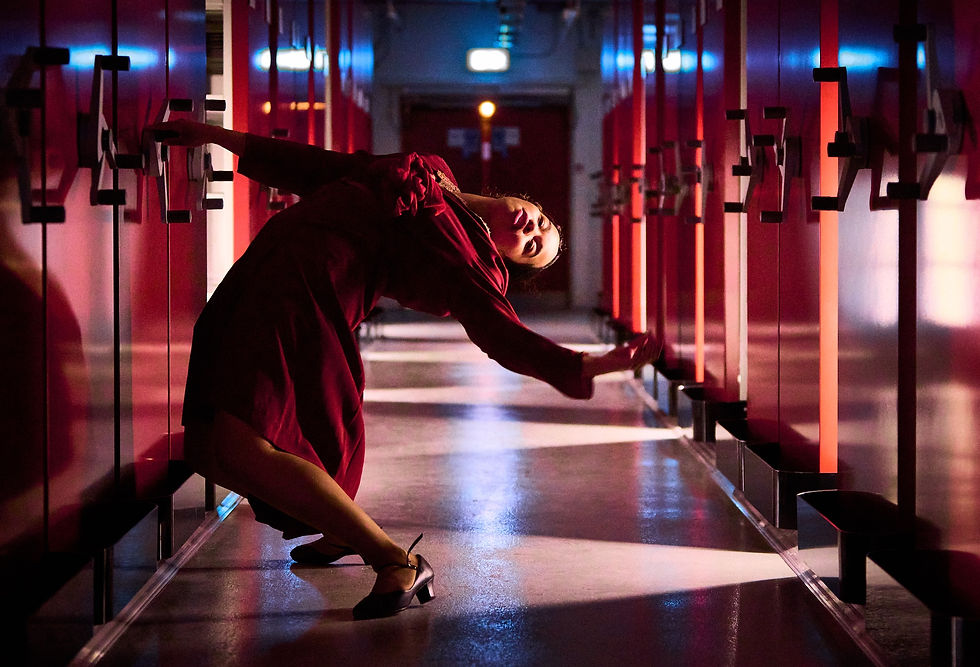
Ghaliah Conroy in The Good Luck Club. Photo: Patricio Cassinoni
What prompted The Good Luck Club's fruitful partnership is the commemoration of the 1926 Census, the State’s first snapshot of the country it hoped to shape. But there’s more to The Good Luck Club than commemoration. The first instalment of a four part, partnership cycle looking at framing the nation, The Good Luck Club sees ANU position The National Archives as a living space of historical presences, both public and private. Evoking low budget, costumed models hilariously trying to shoot a promotional video; talking elephants that guide the audience to their next encounter; interrogative TV interviews looking to expose the truth after a Sweepstakes draw. Or excitable chickens trying too hard, shady deals conducted in shadowed corridors, women confronting each other to give voice to what’s being silenced. All the messy machinations of a fledgling nation made manifest. The Good Luck Club offering a dance with a beautiful woman through Irish history. A holding of that history to account. A reclaiming of forgotten Irish women. A cracking theatre experience. If you thought ANU had nothing new to say now the big commemorations are done with, think again. On the evidence of The Good Luck Club they’re just getting started. Beg, borrow or forge a ticket if you have to. Remember, if you’re not in, you can’t win. The Good Luck Club. Not to be missed.
The Good Luck Club written and directed by Louise Lowe, presented ANU Productions in partnership with The National Archives as part of its Census 1926 programme, runs at The National Archives of Ireland, Bishop Street, Dublin 8, until June 14.
Supported by the Department of Tourism, Culture, Arts, Gaeltacht, Sport and Media.
For more information visit ANU Productions


