Carmen


Niamh O'Sullivan in Carmen. Image, Ros Kavanagh.
*****
It feels like déjà vu. A faint foreboding that you've seen this before. You'd be partially right. Irish National Opera's latest version of Bizet’s Carmen (1875) repurposing much of their 2022 version, in which the impressive Paula Murrihy played the eponymous heroine. Director Paul Curran's Fifties-themed fantasy, framed by Gary McCann's distinctive set and costumes, retro-illuminated by Paul Hackenmueller's majestic lighting and featuring choreography by Muirne Bloomer still very much in evidence. Which might lead some to think they might give this one a miss. They'd be completely wrong. For Carmen isn't a case of the band getting back together so much as key members being swapped out and a whole new set of vocalists drafted in. The result a spellbinding Carmen. One in which mezzo-soprano Niamh O'Sullivan, who has a longstanding relationship with the role, confirms herself as one of opera's newest stars, and one of the all-time great Carmens.
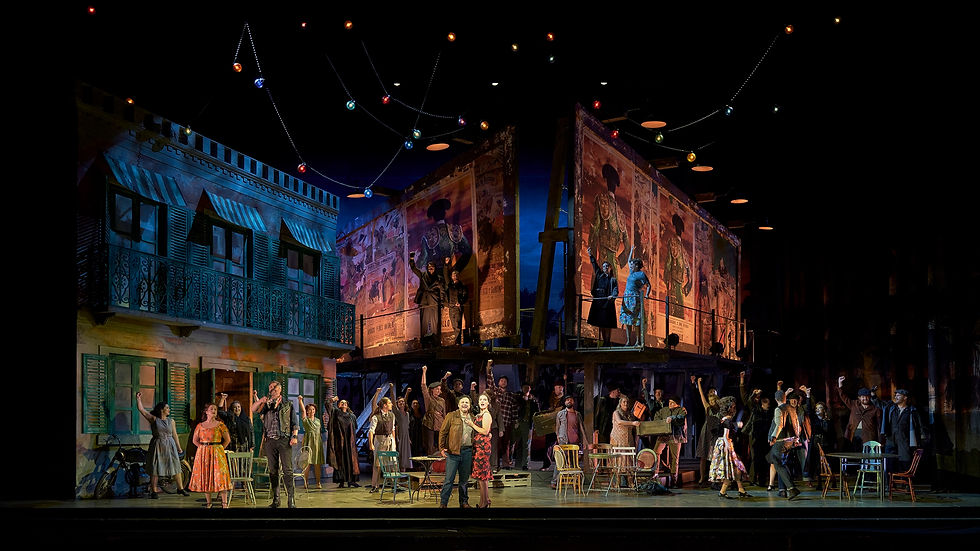
Niamh O'Sullivan (Carmen) & Atalla Ayan (Don José) with cast in Carmen.Image, Ros Kavanagh.
How can you tell O'Sullivan's a star? Stars have an impact far beyond their talent, elevating everyone and everything around them. The stage crackles each time they appear and drops a fraction each time they leave. Everyone raises their game to match the excellence of their performance, all of which O'Sullivan does effortlessly. O'Sullivan the undisputed star of a sparkling constellation. Which includes revival director Sarah Baxter who proves equally sensational. It's no easy feat directing within the visual frame of another director's vision. But Baxter slips the straitjacketing fetters of Curran's family-friendly Carmen to deliver a wildly passionate, kick-ass Carmen. Engaging Eoin McNinch on lights to respond to a greater flow of movement whilst leaving most everything else intact. The changes might seem minimal, but a ship needs only turn half a degree to set off in a whole new direction.

Niamh O'Sullivan (Carmen), Ben McAteer (Danciare) & Atalla Ayan (Don José) in Carmen.Image, Ros Kavanagh.
Not that it's immediately recognisable. A moderately engaging introduction highlights the social life of the square, where soldiers leer and idlers lounge, waiting for the caged cigarette women to be released from their chain locked factory. A flurry of activity in which the Independent Theatre Workshop's Child Chorus, looking like the Von Trapp siblings' poor relations, acquit themselves with requisite cuteness. But everything changes once O'Sullivan's sultry, defiant, complex Carmen performs her legendary Habanera. Even conductor Fergus Sheil, along with Irish National Opera Orchestra, infuse Bizet’s luscious score with greater verve and tenderness once O'Sullivan takes to the stage.

Anna-Helena Maclachlan(Mercédès), Niamh O'Sullivan (Carmen), Jade Phoenix (Frasquita), Christopher Bowen (Remendado) Ben McAteer (Dancaire) in Carmen. Image, Ros Kavanagh
Singing in French, with English surtitles, O’Sullivan's Carmen exudes an easy authority flecked with a wicked glint. O'Sullivan's powerful voice, married to the most supple phrasing, unlocking unplumbed depths. Carmen's authority and sexual confidence given greater emotional complexity as she surveys her devotees, like an unrivalled Cleopatra, from her raised balcony. Her switchblade soul, ready to cut a bitch, landing her on the wrong side of the law. Escape concocted through Eve-like temptations proffered like the forbidden apple. Tenor Atalla Ayan as corporal, Don José, excellently reconfiguring what is often a lovelorn incel by charting his path from disinterest to desire to devotion to despair with compelling sensitivity. Ensuring that we understand, if never excuse. Evident in the stunning duet, Parle-moi de ma mere between Don José and soprano Stacey Alleaume's proud, if innocent, Micaëla. If there are unavoidable chuckles as Don José declares his love for his mother, under Baxter's exquisite direction their duet speaks to some deeper, repressed longing, against which Carmen is both sin and salvation.

If Carmen commands the first act, she owns the second. O'Sullivan, seated on a motorcycle, saying everything even when saying nothing. The Fifties theme made forcibly present with mixed results. Carmen's girlfriends, soprano Jade Phoenix's lively Frasquita and mezzo-soprano Anna-Helena Maclachlan's vivacious Mercédès, found singing for the troops alongside O'Sullivan. The effect less Grease so much as the glorious Shangri-Las. Yet bass-baritone David Bizic's bullfighter, Escamillo, might dress like The Fonz but he more resembles the Fonz's father. Still, bad girls are drawn to charming bad boys who dice with danger and whom they don't have to take care of like a needy child. Bizic's beautifully realised Escamillo fitting the bill perfectly. At which point Don José's number should be up. But the sheer force of the corporal's love, expressed in a gorgeous rendition of the Flower Song, La fleur que tu m'avais jetée, sees Carmen's apathy giving way to empathy. Carmen may claim not to love forever, yet now is the only forever we have. Both her acceptance, and later discarding of Don José as much a sacrifice as a seduction. All beautifully articulated by O'Sullivan even when her back is turned to the audience

Atalla Ayan (Don José) and Niamh O'Sullivan (Carmen) in Carmen. Image, Ros Kavanagh.
If the third act presents a mostly passive Carmen in the smuggler's den, O'Sullivan's electrifies key segments. The third act an opportunity for others to shine, with all rising to the occasion, be they in poorly orchestrated knife fights between Don José and Escamillo, or the sensual silk stockings of Mercédès and Frasquita. As always, the final, problematic act sees a defiant Carmen refuse to run when confronted by Don José's threats. Ayan and O'Sullivan superb as Baxter teases out a sensitive finale which, though we condemn the outcome, we’re made to understand that there are no true heroes or villains. Just soul wounded people struggling to do more than survive and getting it tragically wrong.

A talla Ayan (Don José) and Niamh O'Sullivan (Carmen) in Carmen. Image, Ros Kavanagh.
Opera is the greatest human art form, embodying singing, music, spectacle, performance, text and, on occasion, dance. As an opera. Carmen present true human intensity in all its powerful, imperfect perfection. In a world where art, and criticism, face an encroaching, soulless, well-dressed AI, the expressison and recognition of our shared humanity will prove crucial. Indeed, “reviewing” using AI passing itself off as original work is already happening, though they don’t publicly admit it, their stars and quotable punchlines gracing many a publicists marketing: you don’t have to look far. Art will surely follow if it's not careful. Yet as with Carmen's inherent themes of outsiders, masculinity, and militarisation, Baxter, Ayan and O'Sullivan see no need to proselytise. They trust us. Trust that we can understand the real and true when made to see and feel it. Knowing great opera lies in the details, and that details accumulate. Carmen; a jackpot spilling coin after coin amounting to a fortune. At the centre of which is a sensational O’Sullivan. From the sung to the unsung, scorn weighted eyelids to the flick of a devilish grin, O'Sullivan reigns as Carmen's proud, independent spirit made manifest. A Carmen not to be missed.
Carmen, by Georges Bizet, libretto Henri Meilhac and Ludovic Halévy, presented by Irish National Opera in a co-production with Opera Philadelphia and Seattle Opera, runs at Bord Gáis Energy Theatre November 6, and 7.
For more information visit Bord Gáis Energy Theatre or Irish National Opera


