Dublin Theatre Festival 2026: Testament

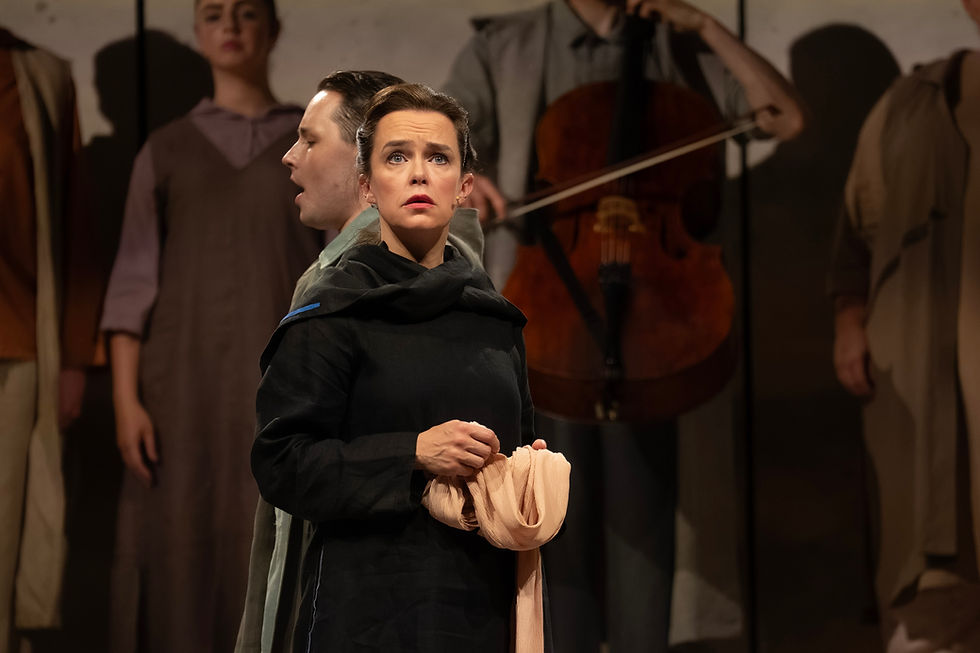
Sharon Carty in Testament. Image, Pat Redmond
***
Talk about life imitating art. Gathered outside the Gaiety Theatre for the Dublin premiere of Irish National Opera's Testament, composed by Tarik O'Regan with libretto by Colm Tóibín, a small pond of placards protested against its alleged blasphemy. Adapted from Tóibín's novella The Testament of Mary, Testament asks who created the Marian narrative and why? Could a very human Mary have been silenced if her story didn't toe the official line? Controversy, tension, all before a note was sung. Subversive art colliding with an act of organised protest. If only it were that sexy. Rather, the whole affair was more Father Ted than Malcolm Muggeridge. Indeed, by the time the opera was over you were left bewildered as to what in the holy mother of mercy people were protesting against? Testament about as blasphemous as saying mass in English, or an unordained woman distributing the Eucharist.
As with his novella, Tóibín highlights a popular practice, one he is himself guilty of. Namely press-ganging Mary into ideological service as it was, in the beginning, is now and probably forever shall be. A quick history lesson should illustrate. Veneration of Mary is nowhere preached in the Bible. Indeed, the Catholic Church did not accord her Immaculate Conception status till 1854. Only then did Pope Pius IX formally define as dogma that Mary was preserved from original sin from the moment of her conception. It wasn't till 1950 that Pope Pius XII officially declared the now Blessed Virgin was assumed body and soul into heavenly glory at the end of her earthly life. Not till 1964 was she named Mother of the Church. Similarly with the Bible, whose books were not ratified till the Council of Rome in 382 AD. Reaffirmed in 1546 at the Council of Trent which also determined the Apocrypha, a collection of fourteen books refused inclusion. And let's not start with the Dead Sea Scrolls, or The Gospel of Mary first discovered in 1896. Clearly Tóibín raises valid questions about what gets included, who is rendered silent and who gets to decide our spiritual narratives.

Sharon Carty in Testament. Image, Pat Redmond
A tall, ambitious order which Testament just about pulls off, whilst never convincing that Mary's story would have undermined the official narrative. Portraying the early evangelists as genuine believers for whom Mary's unbelief in the divinity of her son is seen as misguided. Mary, unimpressed with Jesus's misfit friends, resenting his abandoning her in her widowed old age, ultimately declaring his death not worth it. The story at the foot of the cross the real dogmatic dividing point.
While text speaks to ideology, music tries carry the emotional heft. Long sections resembling the score to Jaws, or Psycho, fabricating a false sense of urgency by way of frenetic ostinato. Singing somewhat problematic in places. Whilst Deirdre Higgins (soprano), Sarah Luttrell (mezzo-soprano), Oisín Ó Dálaigh (tenor), Ben Escorcio (tenor), David Kennedy (baritone) along with the Irish National Opera Chorus prove superb, impact is dimisnhed by an over reliance on short sung statements, like melodious recitative. Snap sentences, like strained Lauds or Matin, undermining deeper emotional engagement. Making for a striking contrast with O'Regan's sublime choral sections. Conductor Elaine Kelly ensuring flow and fluency as musicians and singers mingle onstage weaving layered harmonies with sensual exquisiteness. Channelling the almost mystical arrest of Arvo Pärt's religious music, or the haunting high notes of Gregorian chant. All the while director Rachael Hewer weaves complex movement patterns through Francis O'Connor's layered, desert-coloured set. Joan O'Clery's costumes and Kevin Treacy's lights reinforcing the traditional look of the period.

Sharon Carty in Testament. Image, Pat Redmond
Along with its breathtaking choral sequences, what makes Testament deeply engaging is mezzo-soprano Sharon Carty's superb performance. Carty's Mary, initially gagged and assigned to silence, frowns, glares, snaps, pleas, cries and confesses her Gethsemane. A world-wounded woman wearied by a perplexing humanity. The young Rowan Crowley highlighting a mother's love and loss. References to Lazarus, the Wedding at Cana, even to arm-stretching of the crucifixion coming in a distant second to Carty's vivid portrayal of a widow, mother and woman wanting to proclaim her truth. Knowing that the truth shall set you free. The truth being that Testament is an ambitious, if imperfect, opera, whose choral work is just heavenly. Tóibín and O'Regan never diminishing the significance of Mary, but rather highlighting her perfect humanity.
Testament, created by Tarik O’Regan & Colm Tóibín, presented by Irish National Opera, runs at The Gaiety Theatre as part of Dublin Theatre Festival 2026 until October 10th.
Testament received its world premiere as part of Galway International Arts Festival in July 2026.
For more information visit Irish National Opera or Dublin Theatre Festival 2026


