Dublin Theatre Festival 2026: A Moon for the Misbegotten

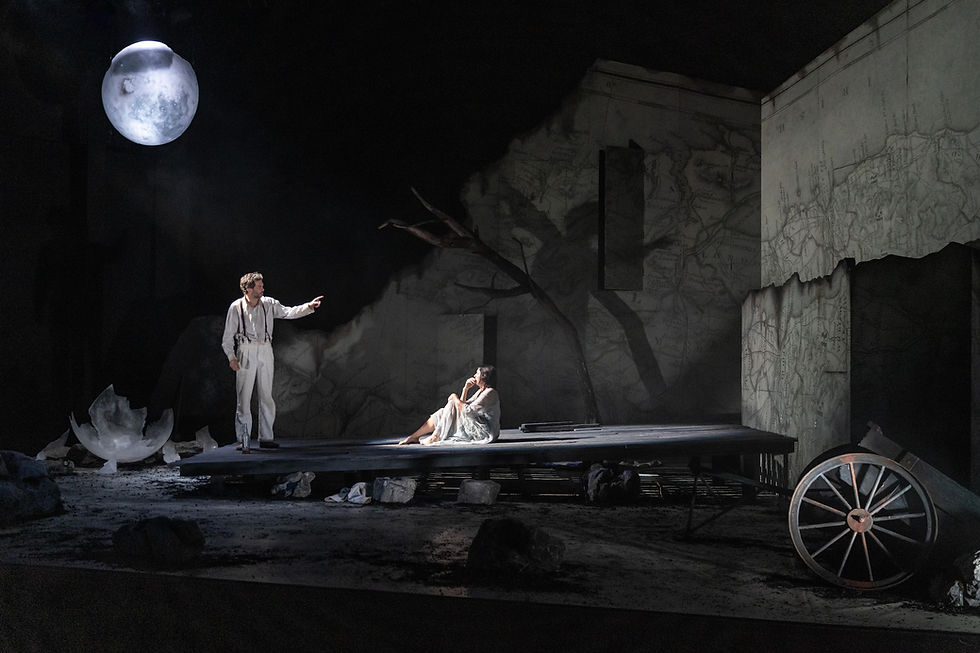
Marty Rea and Eileen Walsh in A Moon for the Misbegotten. Image Ste Murray
***
When first produced in 1947, Eugene O'Neill's A Moon for the Misbegotten was greeted as an utter disaster. It wasn't till 1973, twenty-five years after its initial production, that director Jose Quintero's revival led to O'Neill's final play being reclaimed as an American classic. Then, as now, not everyone was convinced. Druid's current production, part of their Strange Country: Ireland in America double bill, likely to leave the jury hung. Exceptional production values, breathtaking performances, superb staging and direction, A Moon for the Misbegotten is sumptuous to look at. Director Garry Hynes makes strong choices, some of which pay off handsomely. None concealing the myriad of problems haunting O'Neill's troubled play.
What's often agreed is that A Moon for the Misbegotten, the third in an autobiographical trilogy beginning with The Iceman Cometh followed by Long Day's Journey Into Night, is the runt of the O'Neill litter. An indulgent, drawn-out tale featuring James Tyrone Jr. from Long Day's Journey (modelled from O'Neill's own brother Jamie), now a pathetic alcoholic who may, or may not be about to sell a farm. A farm on which the Hogan family have lived for twenty years. Father Phil persuading his un-pretty, agricultural daughter Josie to seduce a drunken Tyrone for whom she has a soft spot. Compromised, he would have to marry her, thereby ensuring their future and a hefty fortune. The reluctant Josie eventually playing along, opening up a Freudian fantasy of Oedipal banality. A splash of sentimentality as their long night travels into day might soften the blow, but it leaves a tacky aftertaste after three long hours.
Hynes's choices, mostly successful, all come at a price. Like the casting of the brilliant Eileen Walsh as hard-working farmer's daughter, Josie, described as an oversized woman with large breasts who is almost a freak. A woman no man would look at even as all are ready to use her for sex. The slim, sensual, supple and sinewy Walsh slinking about in her low-cut summer dress might evoke many things, oversized freak is not one of them. Josie as a laborious, plain Jane reduced to an animal of labour is replaced by Walsh’s wild, independent, sexual and sensuous Josie. Yet the cost is lost vulnerability that punctures lines and scenes and sees the last act fail to land. Woman as saviour or destroyer of men? Hard to see Walsh's independent-minded Josie signing up for that. Whatever benefits, if any, the pay, hours and working conditions alone are dreadful.
Similar issues haunt Lorcan Cranitch's divine, loudmouthed Phil, leaning into a belligerent, cartoonish Michaleen Óge played for laughs. Never more hilarious than when Rory Nolan's cameo as T. Stedman Harder sees Phil and Josie enacting Looney Tunes-level cartoon shenanigans. Raising questions about American representations of the Irish as rude, crude, devious, scheming, sentimental and sad. Or as their stereotypical counterpart, evident in Marty Rea's phenomenal performance as Tyrone; pathetic, self-loathing, self-pitying alcoholics philosophising their misery.
If Long Day's Journey Into Night uses alcohol to lubricate the path towards truth, Rea's haggard Tyrone uses it to disguise a lost boy with Mommy issues. Indeed, mothers, virgins and whores loom large, with many of O'Neill's psychological pillars looking dated even in 1947. Tyrone might be tired of whores, and claim he wants the love of a virgin, but what he really wants is a mother to mind him, love him, forgive him and sacrifice herself for him as she cuddles him, pietà-like, to her womanly breast. His crushing sin, warranting two Hail Marys at best, a disappointing reveal. As Josie concedes, you don't really believe it. Her salvation and completion supposedly lying in becoming Daddy's little minder and helper. Even the most inept incel can see that one's never going to fly. O'Neill, brilliant in so many ways, serving up a ludicrous portrayal of women.
When the end arrives with its sweet twee twist, the feeling is of having spent the evening at a John B. Keane comedy rather than a Eugene O'Neill drama. Or a lightweight comedy with dramatic pretensions that goes on for way too long. Still, Francis O'Connor's pared-back, Connecticut set, with its dust-bowl wind vane turning like tumbleweed, or its shattered, expressionist moon fallen to earth is astonishingly gorgeous. Enriched by James F. Ingalls's haunted lighting. You might wish, when the laughter stops, that they'd hurry up with their long, moaned miseries that fail to convince, but you can't deny the view is somewhat spectacular.
A Moon for the Misbegotten by Eugene O'Neill, presented by Druid, runs at The Gaiety Theatre as part of Dublin Theatre Festival 2026 until October 4th
For more information visit Druid or Dublin Theatre Festival 2026


