Dublin Theatre Festival 2026: 4.48 Psychosis

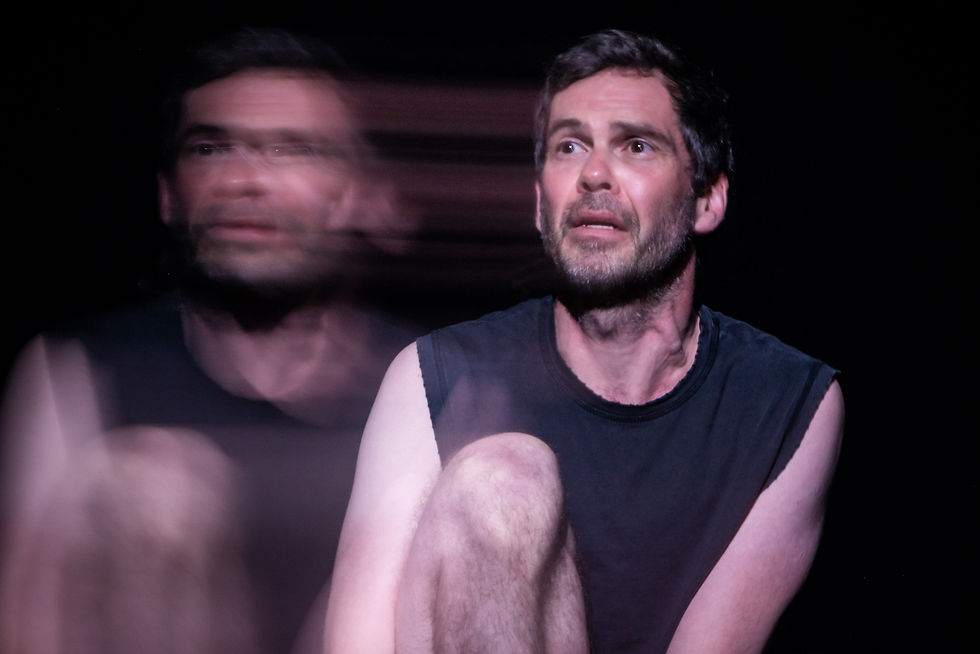
Marty Rea in 4.48 Psychosis by Sarah Kane. Image, Ste Murray
*****
As it enters its final furlong, Dublin Theatre Festival 2026 can consider itself a job well done. Where 2025 saw Artistic Director Róise Goan taking the transitional reins, 2026 sees her stamping her own impressive authority. Productions like the universally adored Zinc and the subversively brilliant Lourdes! The Musical both critically and publicly acclaimed. To which must be added Sarah Kane's awe-inducing 4.48 Psychosis, directed by Tom Creed and starring Marty Rea. Kane, who was diagnosed with clinical depression and died by suicide in 1999, has been posthumously mythologised and venerated. Her final play, 4.48 Psychosis, often interpreted as a suicide note. Its first production in 2000 arriving only a year after Kane's death. Yet is it a study of clinical depression or a meditation on the meaning of life? Closer to the truth to say it is both, neither, and something uniquely and poetically other.
Not that Kane's script is not a masterpiece. Yet with no specific characters it's what you do with Kane's blueprint that defines it. Under Creed's sensitive gaze 4.48 Psychosis yields up its considerable riches and then some. Creed not directing so much as conducting tanglible energies that rise and subside with graceful potency. Rea's genius performance grounded yet transcendent, both here yet not here. Sitting silently in an ordinary chair at the base of Stephen Dodd's rectangle of light, forearms sporting a farmer's tan, biceps white as wet snow; Rea's motionless gaze and impenetrable expression leave you looking in vain at Catherine Fay's understated costume for clues. White socks, black vest and black shorts: gym gear, or a hospital maybe?
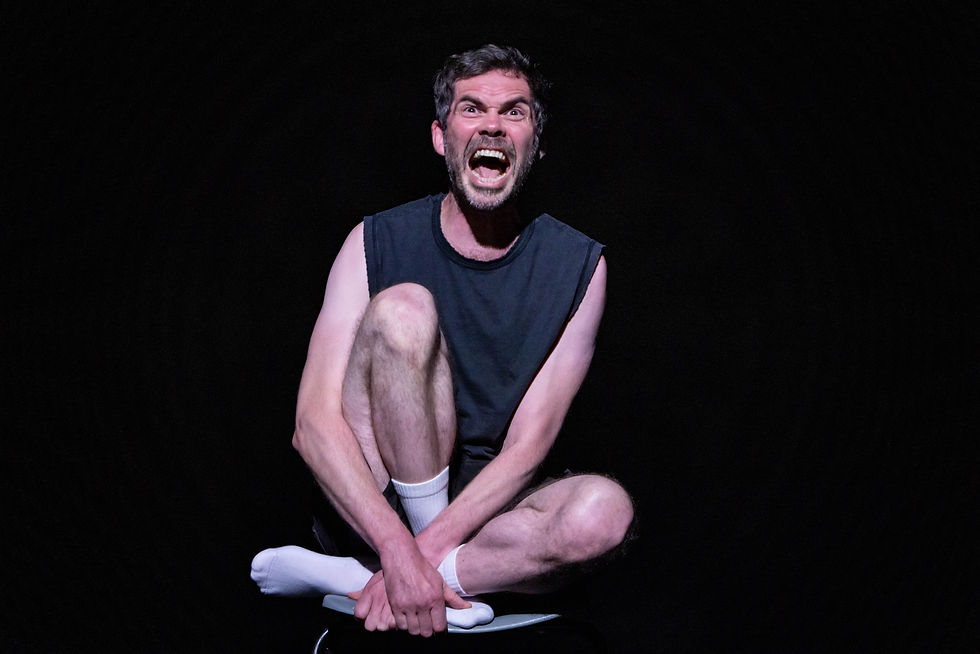
Marty Rea in 4.48 Psychosis by Sarah Kane. Image, Ste Murray
Words begin once Rea's silence holds you in the palm of its hand. His tone dismissive, full of dark ennui underscored by bristles of rage creeping in from a distance. Soon to explode in whipping, volcanic eruptions. Words seeking and offering explanations for what cannot be explained. Justifications for what cannot be justified. Reasons for what can never be reasoned, for life and death are never reasonable. Words, like jagged icebergs, as cold and unsettling as Rea's unblinking stare, sinking titanic hopes, dreams and wishes whilst concealing a disproportionate, emotional overwhelm underneath. One whose coherence and potency is derived from a hidden, contradictory value system. Imbricated urges: I want to die, I don't want to die. I want to live, I don't want to live. See me, don't look at me. I love you, hate you, love that I hate you and hate that I love you. And me? Life? Sanity? The steadying breath of a sleeping lover? Suicide. Both an exit from life and an entrance to death. Hang, overdose and cut just to be sure. Self-harm reminding you of what you can't forget but can never seem to remember.
But I want to live.
The only option medicine that medicates, the side effects worse than the illness. Thoughts muffled, strangled, like the self. I can't go on. I go on. Breaks between the introspective bouts arrive as remembered dialogue with a considerate, uncaring doctor. Echoed reverb, soft rumblings from Ivan Birthistle's nudging sound design, or Dodd's lights shifting from glare to shadow designating shifts. The soft-spoken doctor refusing to climb into the mental shark tank, and refusing to accord the shark tank any other reality than that of a shark tank. Hospital a last hope and desolation. Yet doctors can only heal the sick; they can't raise the dead. Despite protestations to the contrary, claims of clinging to life begin to sound like the lady protesting too much. But whose fault is that? Don't look at what I say, look at what I do. Did you do it willingly, compulsively? Meanwhile life goes on. That is its tragedy and salvation. The real, the unreal, the too real, the really real.
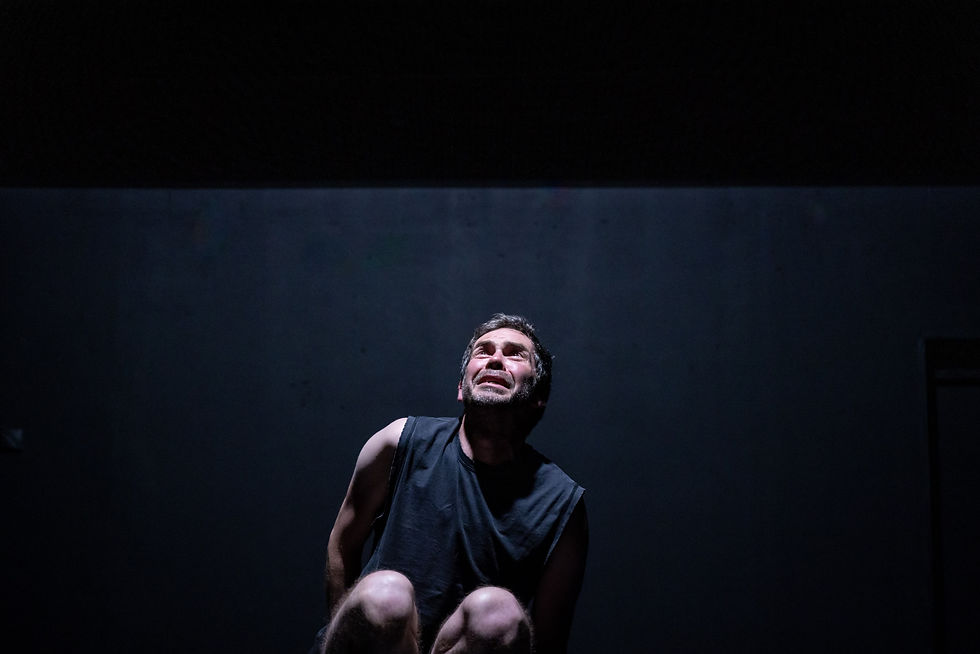
Marty Rea in 4.48 Psychosis by Sarah Kane. Image, Ste Murray
In the hands of a lesser ensemble Kane's musings risk the histrionic or maudlin. Yet Creed and Rea favour restraint, presenting each despairing doubt, each desperate assertion, each effort to understand what can never be understood as an eviscerating, restrained plea. Drawing his knees to his chest Rea's only significant movement. Rea unfurling a universe of hopeless pain and pained hope, lashing out before retreating behind forced composure. Yet are these introspective musings philosophical doubts or psychological disturbance? Are they insane or signs of a different sanity? There might be a clue in the title. 4.48. The hour when psychosis ceases temporarily and clarity visits. Or is that when sanity ends and psychosis visits? Perhaps what we call psychosis isn't the exception to the rule so much as the furthest extremity on the spectrum of sanity. Where the madness of what it means to be sane is shown as responsible for so much pain.
Camus said the only philosophical question is suicide. Perhaps the universe itself is committing suicide. Yet Kane is closer to Émile Durkheim who recognised in suicide a social dimension. Death, like the mind, something more than what is legally and medically defined. When living is dying, death can seem like a possibility of escape. Yet is life a series of problems to be solved, or an insoluble problem? Is 4.48 Psychosis less about seeing through life's blizzard of lies so much as highlighting how we blind ourselves with our own blizzards? Dying as art? Kane's shredding language seems to want to arrive at something visceral, if only it could escape the entanglement of words. Plays like 4.48 Psychosis clear evidence we should never go gentle into that good night. There is something to living, and it can be had. Experiences like 4.48 Psychosis - disturbing, thought-provoking, life-affirming, brilliant - invitations to think about, and think with, what it all means. To start a conversation rather than talk, alone, to oneself.
If you see only one monologue this year, make it 4.48 Psychosis.
4.48 Psychosis by Sarah Kane, presented by One Off Productions, runs as part of Dublin Theatre Festival 2026 at Project Cube till Oct 11.
For more information visit Dublin Theatre Festival 2026
Should you find yourself affected by this review, or by 4.48 Psychosis, help is available at FindAHelpine


