The House Must Win


Niall McNamee and Tabitha Smyth in The House Must Win. Credit, Ruth Medjber
*****
It might be set in the west of Ireland during the 1970s but make no mistake, Mick Flannery's musical, The House Must Win, is a Western. A six gun, poker playing, shot down in the prime of life Western. Where drunkards, gamblers and honourable men loiter in a smoky saloon as the last train whistles in the distant darkness. Men doing, or failing to do, what a man's gotta do. Independent women, dependent on men, hankering for a better near or faraway. But life doesn’t care much and family proves as much a burden as a blessing when secrets and lies make their way to the surface. Flannery’s superlative marriage of script and score, exquisitely staged and brilliantly performed, making for a potent, dramatic cocktail.
Set in a one horse town where the horse left years ago, soon to be followed by the train, brothers Luther (a superb Ferdia Walsh-Peelo) and Frank (an equally superb Niall McNamee) find themselves trapped in a dead end in the middle of nowhere. Where family matters mean family matters. Frank, a hard working barman, dreams of escape. Luther, like their degenerate father, is a Cincinnati Kid playing five card stud at a game run by the ruthless bar owner Ray (a superb Tommy Tiernan relishing the role). Both brothers in love with the independently minded Grace (a sublime Tabitha Smyth), the desirable daughter of scheming Ray. Grace, with her haughty personality, well to do father, and the fact she seems to be the only eligible girl in town, is also desired by slime ball bank manager Paulie (a squeamishly brilliant John McCarthy). Their lives to be decided by the turn of some friendless cards. In which debts must be paid, women bought and sold, and a dead man's hand might offer a flicker of hope for a better, or bitter tomorrow. Where wounded mother Sarah (an electrifying Orlagh De Bhaldraithe), and lovelorn spinster John (Damian Kearney so good you have to see it to believe it) might also have a chance at a second chance. If only all are brave enough to step out of the gutter and play the hand they’re dealt. And the game isn’t already rigged.

Ferdia Walsh-Peelo, John McCarthy, Damian Kearney, Tommy Tiernan in The House Must Win. Credit, Ruth Medjber
Those in search of a disposable musical like Hercules, or The Hunger Games, keep looking. Flannery’s mish mash of musical genres, honed dialogue and exquisite arrangements digs deep rather than skims the surface. The House Must Win representative of a far richer musical tradition. Echoes of the brilliant Blood Brothers, to which it owes more than a passing nod, and the overwhelmingly brilliant Next to Normal speak of durability. In which entertainment is capable of breaking your heart and healing your soul. Like Tom Waits, Flannery’s honky-tonk hybrid of disparate musical genres are woven into his own signature sound. Flannery’s songs at once character centred, driving the narrative, and capable of standing alone. Sultry, soulful, sexy, sincere; vocal demands, range from Leonard Cohen grumblings to power soared heights. Soaring best exemplified by Smyth and De Bhaldraithe. Smyth, a star in the making, sings Grace like a hooded soul burning to reveal itself, longing for a far away, better day tomorrow. De Bhaldraithe’s Sarah leaving you begging for more as a world weary woman carving her hurts into the wall of your heart. The men no slouches either, even if frequently constrained within the baritone/bass register. Which has its textural compensations, but can cost in terms of range on occasion.
Lacking a Broadway, blockbuster budget, The House Must Win proves a victory of imagination over finance. Ciarán Bagnall’s set and lights a masterpiece of ingenuity. Smoke shadowed elegance infiltrating a wraparound ramp leading to a Juliet balcony. Beneath which a bar is pressed and an array of musicians hunker with their army of instruments. Deirdre Dwyer’s costumes revealing pop stylings in period detail. Director Julie Kelleher whisking the visual, performative, musical, vocal, choreographic and even stage fighting ingredients into an energised whole. Kelleher a mistress of harmony and a master of her craft. Yet in the end, it’s all about Flannery, whose music, script and lyrics demand The House Must Win should run and run and run. And be in the running for every conceivable award. And when they give out awards, Damian Kearney as the scene stealing John, a sort of loveably drunken, beligerent Walter Brennan, deserves every accolade possible.
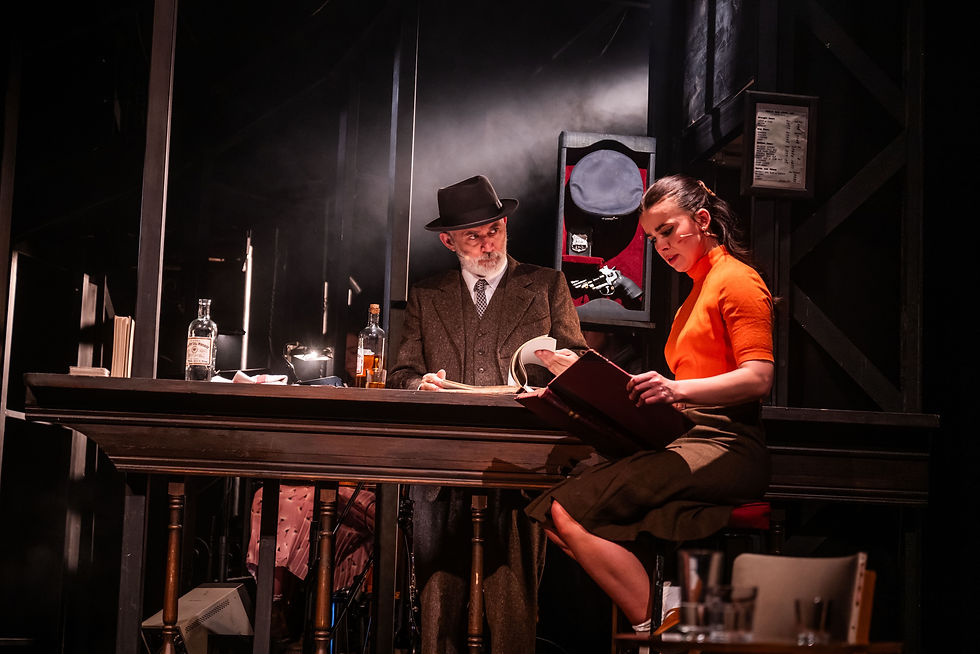
Tommy Tiernan, Tabitha Smyth in The House Must Win. Credit, Ruth Medjber
You could talk about The House Must Win’s detailed historical references, like abolishing the gold standard, or argue the pros and cons of its punkish, jazzy, Dylan meets country styled folksiness, but you don’t need to to enjoy what is a breathtaking musical. Nor do you need to be familiar with Flannery's 2005 album Evening Train, which provided the inspiration that has evolved into a full fledged musical. One with its own, must have double album soon to be released on May 8th. It’s been a long, hard road getting here, but well worth the wait. The House Must Win a wildly refreshing, utterly heartfelt and hugely invigorating experience. Quite simply one of the best new musicals of recent years. Not to be missed.
The House Must Win by Mick Flannery, based on his album Evening Train, runs at The Pavilion Theatre, Dun Laoghaire until May 3rd, transferring to The Everyman, Cork, May 6th to 16th.
For more information visit The Pavilion Theatre or The Everyman


