Sorry You Felt That Way
- Chris O'Rourke
- Apr 30
- 4 min read


Hannah Brady and Chloe O’Reilly in Sorry You Felt That Way. Photo, Michael Lowther
***
Winner of the Fishamble New Writing Award 2024, Harry Butler's Sorry You Felt That Way is a polemic of genius undone by naive gender bias. A play doing the exact opposite of what it thinks it’s doing. Butler's study of Dubliner Adam, and his slightly younger Cork girlfriend Emma, more likely to confirm gender prejudice than challenge it. Emma, a student with dead Daddy issues, loves caring and considerate Adam and has moved into his apartment after six months together. Alone one night, she disturbingly finds his ex, a tetchy and ragged Elouise, rocking in her Crocs having let herself in. Like a stalker trained as a STASI interrogator, the lying Elouise manipulates and gaslights the bath-robed Emma into revealing details of her life. Unconvincingly, Emma complies, oversharing with a suspicious stranger she’s every reason to distrust till the reveal reveals Elouise’s hidden agenda. No, it’s not revenge, nor trying to break them up, and has nothing to do with Adam throwing her out after she slept with someone else the distraught Elouise insists repeatedly. She’s there to warn Emma that Adam is controlling and abusive. Blaming him for not taking responsibility for her having cheated on him because his comments drove her to it. As the lady protests too much, battering Emma into submission by the unrelenting force of her personality, the gaslit flames grow higher till Emma is consumed and Elouise leaves like a heaved sigh. So far, the only one trying to bend Emma to their controlling will is Elouise.
And it works. Scene Two. Enter Adam. Smarmy, arrogant, constantly performing and living off Daddy’s money, Adam is many annoying things but controlling and abusive doesn't immediately spring to mind. But Butler has planted the idea of Adam grooming vulnerable younger women, so the gaslighting Emma, along with the baited audience, put the ambushed Adam on trial without him knowing he’s on trial. To Emma, who hasn’t told Adam about his nemesis visiting, it’s not a trial, and not because of Elouise, and not because she, like us, is now seeing everything as a red flag, but because Emma innocently wants to know if Adam hurt any of his ex-girlfriends? He smells something amiss. She ask why he’s being so defensive. The suggestion of coercive sex falling short of motivation in the absence of proper exploration. Like everything else, it’s alluded to but not explored. Emma eventually confessing to Elouise’s visit and demanding answers. Which, like evidence, her accusations, and Adam’s defence are vague and inconclusive. A cleverly structured coda might strive for clarity, but it tells us nothing, neither confirming nor denying, only hinting at everything and its opposite.
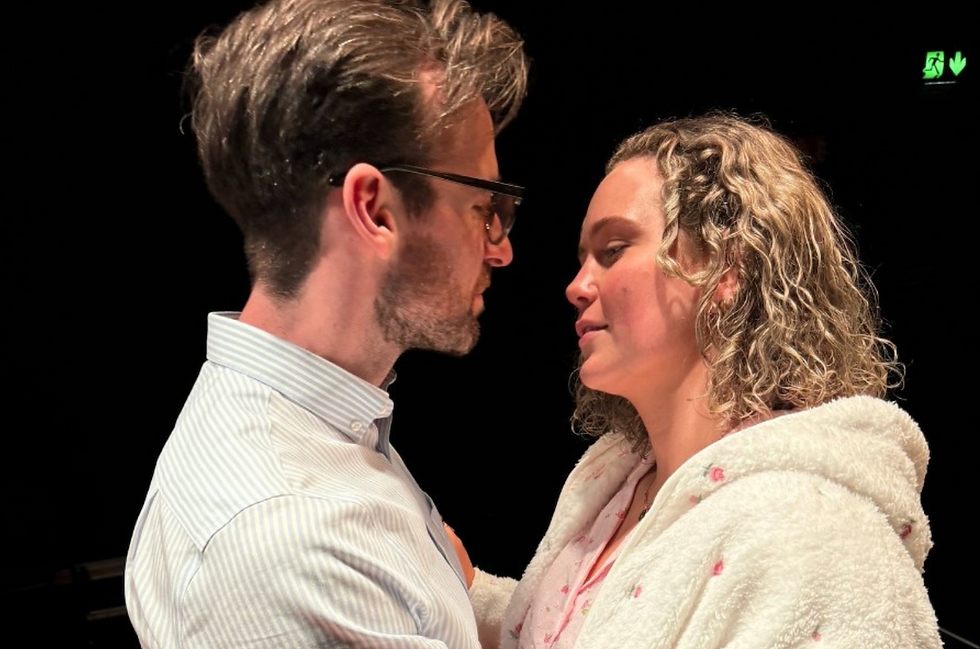
Harry Butler and Hannah Brady in Sorry You Felt That Way. Photo, Michael Lowther
Like a Meisner exercise, talk is action and it generates heat. Butler’s gift for writing intense, passionate dialogue very much in evidence. Detailed language steeped in everyday observations and conversational urgency whisking arguments along. But they never catch fire, being less debates so much as personal power plays asking to be taken as evidence. An interrogation insisting it’s a conversation that can explain everything away. Director Anthony Biggs cranking up a palpable, oppressive pressure till it feels like suffocating. Yet with stakes too low, arguments too flawed, resolution nowhere in sight, the wheels turn frantically but go nowhere. Butler as the accused Adam, Hannah Brady’s Emma as witness for the prosecution, and Chloe O’Reilly’s electrifying Elouise playing the plaintiff looking like weakly loaded dice. Yet Biggs has cast brilliantly and in Butler, Brady and O’Reilly elicits three staggering performances. But the problem remains; whether Butler intends to highlight misogyny or misandry, or both, it’s hard to know. But you can take a stab at it.
In her brilliant Conflict Is Not Abuse cultural critic Sarah Schulman coined the phrase ‘overstating harm’ to highlight the dangers of claiming as traumatic events that weren’t traumatic, or calling something abusive which was not abuse, thereby undermining the very real claims of real abuse victims. Were it positioned as a play where everyone is guilty and the abuse clear, Sorry You Felt That Way might have something real to say about gender manipulation and power plays. Yet while you want to give Butler the benefit of the doubt, overstating harm is the overriding sense Sorry You Felt That Way leaves you with. Butler ascribing politicised power plays to Adam to encode the natural friction of two young people learning to live together with blame and misogyny. Which might often be true, but the jury here, if it’s honest, is split for points being made even though the case isn't. For if Adam is a player, he is also very much being played. Both distrusting women seeking to control their alleged controller, who craves their validation. Reinforcing the same old gender binaries. Ensuring history repeats itself, risks victims remaining unbelieved, and the innocent continue to fall victim to unfounded accusations. If these are the terms of love’s new normal, most would be better off living alone. Not even three glorious performances would make you want to risk these kinds of relationships. Yet when it slips the reins of Butler’s bias, and is subject to a more honest gendered reading, Sorry You Felt That Way packs considerable punch, raising serious questions about gender control and power dynamics.
So which version will you see?
Sorry You Felt That Way by Harry Butler, runs at Smock Alley Theatre until May 9th,
Transferring to Hope Theatre, London, May 26th to 30th.
For more information visit Smock Alley Theatre


