New Critical Voices: Helene Ott on Uncle Vanya


Maria Oxley Boardman, Risteárd Cooper and Nick Dunning in Uncle Vanya. Image, Olga Kuzmenko
****
How much weight can the uneventful carry? Brian Friel's adaptation of Anton Chekhov’s Uncle Vanya at Smock Alley Theatre, directed by Cathal Cleary, offers a visceral answer. The titular Vanya (Risteárd Cooper) working a rural estate alongside his solicitous niece Sonya (Eavan Gaffney), sends all profits to Alexander (Nick Dunning). Sonya’s father and Vanya’s brother-in-law, Alexander is a professor of fading prestige and fortune. Vanya’s disillusioned envy not helped by his anarchist mother’s (Catherine Byrne) admiration of the Professor. An industrious Nanny (Eleanor Methven) and German-obsessed guitarist Ilya (Morgan C. Jones) complementing the tragicomedy ensemble. Topped off with discontented Doctor Mikhail Astrov (Adam Fergus) who visits the estate diligently, to Sonya’s delight. All victims of circumstance and routine, their conflicts unravel due to the interruption of uneventful normalcy by a prolonged visit of the Professor and his alluring but jaded wife, Elena, (a brilliant Maria Oxley Boardman). The subsequent emergence of seething disdain and desire reflecting differently on each character as Cleary probes the play’s many hidden tensions.

Eavan Gaffney and Adam Fergus in Uncle Vanya. Image, Olga Kuzmenko
At the centre of which is the tension between Elena and Sonya. Where Gaffney’s Sonya brims with earnest hope and hunger, loving naively and desperately, Elena observes and speaks with disheartened temptation. But while Boardman could've buried Elena under defeated ennui and despondency, she plays her as something preying that longs for release and connection. Boardman’s Elena a woman bored to death brought back to life. Her desire to escape her stagnant existence sustained through the relentless admiration of three men who leave her misconceived. Her husband Alexander too preoccupied with his ailments of old age to inspire passion. Vanya’s crude advances stemming from spite rather than genuine attraction. Only in Mikhail does Elena finds her match, the only man whose affection appears sincere. Mikhail might not truly see her, but he does like to look. Like Elena, he's not driven by love but seeking a remedy to stuff the hole inside of him. Embodying the unfulfilled doctor, Fergus’s impressive performance takes on much of the emotional weight and charming contradiction you traditionally expect to find in Vanya. Wrapped up in misery and obsession, Mikhail would rather confine himself in the crumbling estate to pursue Elena, rambling about forest preservation than actually committing to his environmentalism.
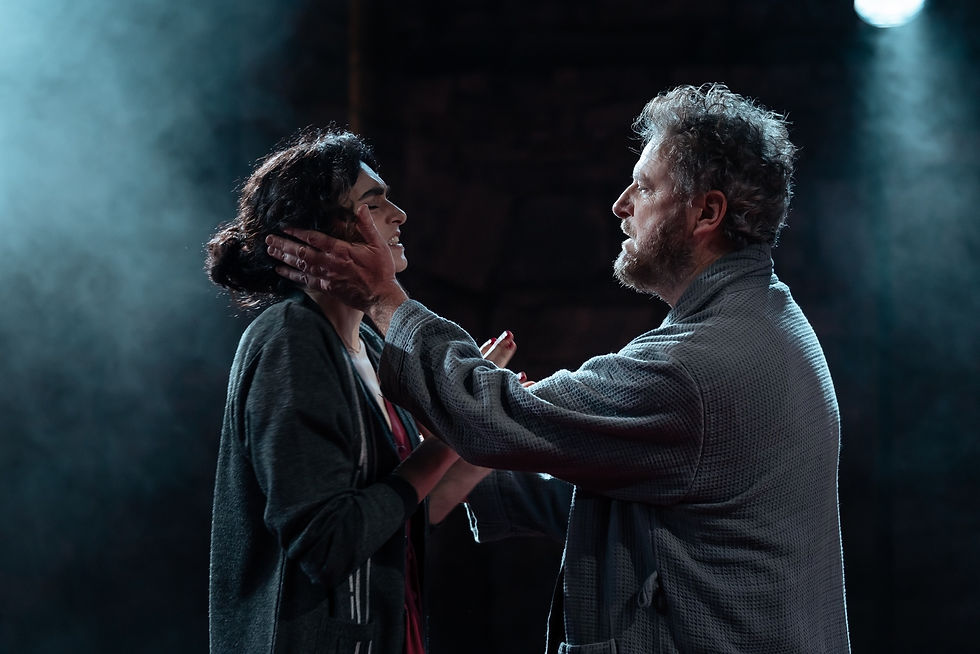
Maria Oxley Boardman and Risteárd Cooper in Uncle Vanya. Image, Olga Kuzmenko
Yet Elena imagines Mikhail a true visionary, whose eccentric passion interrupts her inertia. Boardman embodying a simmering desire that yearns to boil, but mostly stagnates in cold indolence. Lying in wait but resigned to never move. The pivotal farewell-embrace between Mikhail and Elena particularly cathartic, accentuating Elena’s sexuality and autonomy as she is the one kissing Mikhail. Rather than being an object of desire, she becomes a subject that desires both viscerally and dispiritedly. The love triangle given vivid life as Fergus realises Mikhail’s idealist monologues with a passion that inspires Elena’s attraction and Sonya’s hopeless adoration. Elena, whose initial admiration for her husband has faded, regards Sonya's infatuation with pity and envy, but seeks her friendship nevertheless. In mutual loneliness and desire, Sonya and Elena form a vulnerable bond, anchoring the audience in a reconceptualisation of the play as the focal point is shifted; centring not on the titular character but its heroines. Boardman and Gaffney taking the spotlight and casting Vanya into a state of passivity usually reserved for the women of this play. Gaffney leading with a beating heart that breaks and endures, prompting ours to do the same. Guiding you through emotional unweaving until you wonder why the play isn’t called Sonya.

Risteárd Cooper in Uncle Vanya. Image, Olga Kuzmenko
Unfortunately, and strangely, all this is achieved at the cost of Vanya. Cooper portrays the play's supposed protagonist as trapped in a slouching aimlessness where resentment and restlessness are articulated but not believably conveyed. His snarky comments carrying the same emotional gravity as his monologues, whether bitching to a wall, or himself, rather than the audience. Only when breaking down in front of Sonya do we get a glimmer of Vanya’s ungovernable grief and Cooper’s wasted potential. If Vanya is left wrecked by anguish about his failure at shooting the Professor, the violent attempt feels so utterly unprovoked. Further undermined by ineffective staging of the gun scene that renders the climax unanticipated, undeserved and unsatisfying, eroding the emotional impact of its aftermath.

HK Ní Shioradáin (rear) and Maria Oxley Boardman in Uncle Vanya. Image, Olga Kuzmenko
As the end nears the desolation of things falls back into place as the Professor, Elena and Mikhail leave and an enduring monotony spreads over the estate once again. Evoking something quietly devastating in Sonya’s soldiering on through rejection and heartbreak. Gaffney’s performance materialising a love for Mikhail that, in the end, hangs in the air with nowhere to go. A devastation made possible through Sonya’s previous enthralling innocence. Vanya’s final loss of dignity, on the other hand, leaves you indifferent as his emotional journey is not satisfyingly realised. The performance evoking no fall from grace, or even descent from decency, only a man rolling into himself like a Sisyphean snowball of accumulating self-pity. Trapped in a small world of desire and defeat.

Eleanor, Methven, Risteárd Cooper and Maria Oxley Boardman in Uncle Vanya. Image, Olga Kuzmenko
A world given form by Maree Kearns minimalist set design, featuring the basic elements of a living room, like vestiges of a life un-lived and a space uninhabited, both familiar and estranging. The stage, wide and enclosed, a claustrophobic threshold between worlds; the crumbling estate and everything beyond. The confining set generating a wonder and ache for the outside world which encroaches, creating a bond between the characters and the audience. Cleary’s directing undeniably effective in achieving a fragile immersion that pushes at the edges of realism. At certain times all actors crowd the stage and your eyes linger on a specific, highly intimate moment that completely shifts the scene's affect. A flinch, a brief touch of hands, lost on everyone but you. Wherever you turn your gaze a private encounter sustains the play's realism, shattered when you break your gaze from one character to another. This breach of passive automaticity captivating and constant. A looming piano centred in the backdrop, eerily played by HK Ní Shioradáin, her back turned, alienates the audience and defamiliarises the realist stage. The discomforting further imposed by Martha Knight's agitating sound design and Stephen Dodds disuniting use of beam lights. This transgression of realism recovering some element of the overstimulating, sensory experience of life itself, becoming more real as a consequence.

Morgan C. Jones and Adam Fergus in Uncle Vanya. Image, Olga Kuzmenko
By the end, you might not be wrecked by existentialism, overwhelmed by spectacle or heartbroken by the unbearable weight and spool of routine, but the play lingers with profound intensity. Cleary’s Uncle Vanya going beyond what’s expected to reveal what lies beneath. An entire reality so compellingly compressed onto the small stage, when you stagger out of the theatre you get brief whiplash. Witnessing Uncle Vanya like living through a full life of simultaneous insignificance and deep meaning. The production brimming with the essence of what it means to be, and to want and to not be able. Cleary’s intimate staging and the alluring ensemble rendering the experience deeply personal.

Eavan Gaffney and Risteárd Cooper in Uncle Vanya. Image, Olga Kuzmenko
Maxim Gorky once fondly accused Chekhov of ‘killing realism’, arguing ‘no one can write as simply about such simple things as you can’. With every Chekhov production comes the inevitable responsibility to stage realism only to kill it all over again. Until the claim that “nothing happens in a Chekhov play” is buried right next to the corpse of realism. Unlike Vanya, Friel and Cleary were very successful at their attempted killing. As delightfully boring, painful and elating as reality itself, Uncle Vanya delivers a brilliant adaptation of Chekhov's masterpiece.
Uncle Vanya by Anton Chekhov, presented by Smock Alley Theatre and Cathal Cleary Theatre Company in association with Once Off Productions, runs at Smock Alley Theatre until December 20.
For more information visit Smock Alley Theatre
Helene Ott is a student of English, Drama, and Film at University College Dublin. Alongside her studies, she works as a writer, painter, and freelance photographer specialising in portraiture and visual storytelling.


